
Journal
What Is Damascus Steel? History, Layers & How It Is Made
May
Damascus steel is one of the most recognisable materials in the knife world — and one of the most misunderstood. The name gets applied to everything from mass-produced pattern-welded blades to genuine hand-forged knives with hundreds of layers. This guide explains what Damascus steel actually is, how it is made, what the layer count means, and why it matters when you are choosing a knife.
The Origin of Damascus Steel
The original Damascus steel — known as wootz — was produced in the Middle East and South Asia from roughly 300 AD to the 1700s. Blades made from wootz steel had a distinctive watered or flowing surface pattern and were renowned for their sharpness and toughness. The exact method of producing wootz was lost over time, and the original formula has never been fully replicated.
Modern Damascus steel is a different material — pattern-welded steel — that produces a similar visual appearance through a different process. It is not a reproduction of the original, but it is a legitimate craft with its own history, going back centuries in both European and Japanese sword-making traditions.
How Modern Damascus Steel Is Made
Modern Damascus steel is made by forge-welding two or more types of steel together, then folding, drawing, and twisting the billet repeatedly to multiply the layers. The basic process:
- Stacking and welding: Two types of steel with different carbon content are stacked in alternating layers and forge-welded together at high temperature.
- Drawing and folding: The billet is hammered out, folded back on itself, and welded again. Each fold doubles the layer count.
- Shaping: The smith shapes the billet into a blade profile, grinding and filing to the final geometry.
- Heat treatment: The blade is hardened and tempered to achieve the correct balance of hardness and toughness.
- Acid etching: The finished blade is submerged in acid, which reacts differently with the two steel types, revealing the flowing, wave-like Damascus pattern.
The final pattern — whether it looks like flowing water, wood grain, or tight ladder steps — depends on how the billet was manipulated during forging. Each bladesmithhas their own techniques, and no two Damascus blades are identical.
Real vs Fake Damascus: How to Tell the Difference
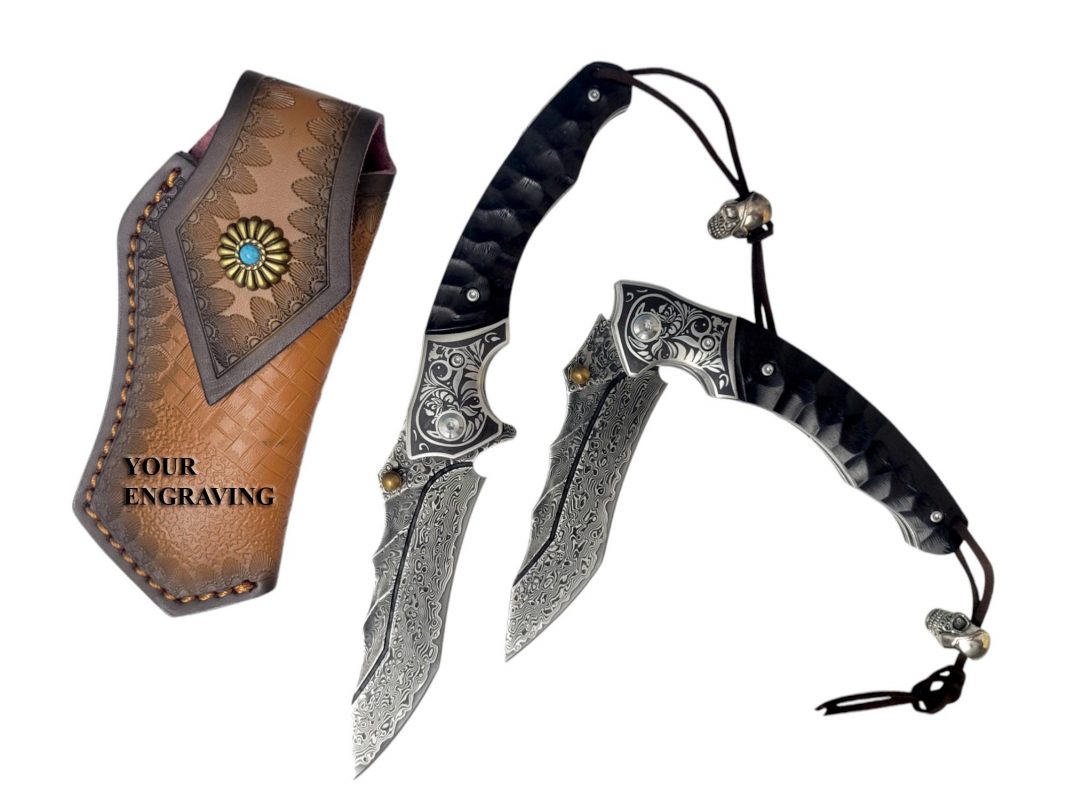
Because the flowing pattern is so desirable, some “Damascus” knives on the market are imitations — the pattern is chemically surface-etched, acid-stamped, or laser-printed onto a single piece of ordinary steel to mimic the look. On genuine pattern-welded Damascus, the pattern is a physical property of the blade: it is created by the forge-welded layers themselves and only revealed by acid etching, so it runs all the way through the steel rather than sitting on the surface.
A few ways to tell real from fake:
- The pattern wraps the edge and spine. On real Damascus the banding continues around the blade because the layers are three-dimensional; a printed pattern usually stops at a polished bevel.
- It never perfectly repeats. Forge-welded layers produce organic, one-of-a-kind patterns, while a machine-printed pattern often repeats.
- Sharpening does not remove it. Grinding a genuine Damascus edge reveals more layered pattern; grinding a surface-etched fake removes the pattern and exposes plain steel underneath.
- Construction is described honestly. Genuine Damascus is described by its steel and layers — for example a VG10 core clad in forge-welded layers (San Mai construction). Vague “Damascus finish” or “Damascus design” language is a red flag.
Every Damascus knife at Fair Impex is genuine pattern-welded steel — a VG10 core clad in forge-welded Damascus layers, revealed by acid etching — never surface-etched, printed, or engraved.
What the Layer Count Actually Means
Layer count is one of the most discussed — and most misunderstood — specs on Damascus knives. Here is what it actually means.
When a billet is folded once, the layer count doubles. Starting from two layers:
- 1 fold = 4 layers
- 2 folds = 8 layers
- 5 folds = 64 layers
- 6 folds = 128 layers
- 7 folds = 256 layers
Higher layer counts produce a finer, more intricate pattern because the individual layers become thinner. At 67 layers, the Damascus pattern is bold and clearly visible. At 107 layers, the pattern becomes denser and more refined — closer to the appearance of natural grain in stone or wood.
Layer count does not determine sharpness or edge retention on its own — that is determined by the steel alloys used and the heat treatment. A well-made 67-layer blade will outperform a poorly made 256-layer blade every time.
The Role of VG10 Core Steel
Many premium Damascus folding knives — including all of the knives in the Fair Impex Damascus collection — use a VG10 core steel surrounded by Damascus layers.
VG10 is a Japanese stainless steel developed specifically for high-performance cutlery. It contains vanadium, cobalt, and chromium, which give it a Rockwell hardness of approximately 60–62 HRC. This means the cutting edge — which sits at the very centre of the blade — holds its sharpness exceptionally well under regular use.
The Damascus outer layers serve two purposes: they add the visual pattern, and the alternating hard and softer steel layers give the blade overall flexibility, reducing the risk of chipping or snapping under lateral stress.
Handle Materials in Damascus Knives
Handle material is the other major variable in Damascus knife quality and aesthetics. Common materials include:
- Rosewood: Warm reddish-brown tone, dense and durable, classic look that pairs well with the Damascus pattern.
- Ox bone: Natural ivory-like material with its own grain pattern. Each piece varies slightly in colour — no two handles are identical.
- Abalone shell: Iridescent, shifting between greens, blues, and purples depending on the light. The most visually striking option.
- Ebony: Dense black hardwood, often used with floral or mosaic inlay work for a high-contrast look against the Damascus blade.
- Brass bolsters: Some handles pair brass fittings with wood or bone, adding weight and a warm metallic accent at the junction between blade and handle.
Damascus Steel vs Stainless Steel: What to Choose
Damascus steel knives with a VG10 core have excellent corrosion resistance — comparable to standard stainless steel — because the core steel that forms the cutting edge is stainless. The outer Damascus layers may require slightly more care to prevent surface oxidation, but a quick wipe after use and occasional oiling is sufficient for most users.
For everyday carry and practical use, a VG10 core Damascus knife performs on par with premium stainless steel knives of similar construction quality — while adding an aesthetic that no plain stainless blade can match.
What to Look for When Buying a Damascus Knife
- Core steel specification: VG10 is the benchmark for premium Damascus EDC and folding knives. Avoid knives that do not specify the core steel.
- Layer count: 67–107 layers is the standard range for quality handmade blades. More layers means a finer pattern, not necessarily a better blade.
- Handle material: Natural materials (rosewood, ox bone, abalone, ebony) are a sign of quality craftsmanship.
- Lock mechanism: On folding knives, a liner lock is the reliable standard for EDC use.
- Handmade vs factory: Genuinely handmade Damascus blades will have slight natural variation in the pattern — this is a feature, not a flaw.
The Fair Impex Damascus steel folding knife collection includes 15 handmade knives ranging from 67 to 107+ layers, with VG10 core steel and natural handle materials including rosewood, abalone shell, ox bone, and ebony. Every knife ships in a presentation gift box. Browse the full collection here.
