
Journal
How to Care for a Damascus Steel Knife: Cleaning, Oiling & Sharpening
May
Damascus steel knives with a VG10 core are robust, capable blades — but the layered Damascus surface requires slightly more attention than a plain stainless knife. The good news is that proper care takes less than five minutes and protects your knife for decades. This guide covers cleaning, oiling, sharpening, and long-term storage for Damascus steel folding knives.
Understanding Why Damascus Steel Needs Care
The flowing pattern on a Damascus blade comes from acid etching — the acid reacts differently with the high-carbon and low-carbon steel layers, revealing the contrast between them. This etching process also opens the steel’s pores slightly, making the surface more susceptible to oxidation than a polished plain stainless blade.
Knives with a VG10 core have good corrosion resistance at the cutting edge — VG10 is a stainless steel and performs like one. The outer Damascus layers may develop surface rust spots if left wet or exposed to salt without cleaning. This is not a structural issue, but it will affect the appearance of the pattern over time if left unaddressed.
After Every Use: Wipe and Dry
The single most important habit for Damascus knife care is the simplest: wipe the blade dry after every use. Moisture — especially salt-laden moisture from food prep or sweaty hands — is the primary cause of surface oxidation.
- Wipe the blade with a clean cloth or paper towel immediately after use.
- Pay attention to the fuller (if present), the ricasso, and the area near the pivot on folding knives — moisture collects in these areas.
- If the blade was used on acidic foods (citrus, tomatoes, onions), rinse briefly with water first, then dry thoroughly.
- Never leave a Damascus blade sitting in a wet sink or submerged in water.
Monthly Oiling
A light coat of oil on the blade once a month — or after any heavy use — keeps the Damascus surface protected and maintains the depth and contrast of the pattern.
Recommended oils
- Mineral oil: Food-safe, widely available, and effective. The best choice if you use the knife for food preparation.
- Camellia oil: Traditional Japanese blade oil, excellent for carbon and Damascus steel. Thin, clear, and does not go rancid.
- Renaissance Wax: A microcrystalline wax used for conservation — good for collector pieces that are handled but not used for cutting.
- Knife-specific blade oil: Products like Ballistol or Sentry Solutions TUF-GLIDE work well for Damascus steel.
How to apply
- Apply a small drop of oil to a soft cloth or cotton pad.
- Wipe across the flat of the blade in the direction of the grain, covering both sides and the spine.
- Use a clean dry cloth to remove any excess — you want a thin, invisible protective layer, not a greasy surface.
- On folding knives, apply a tiny drop to the pivot point and work the blade open and closed a few times to distribute it.
Removing Surface Rust Spots
If you notice small orange or brown spots on the Damascus surface, act quickly — fresh surface rust is easy to remove. Old rust that has been left to develop can be more difficult to address without affecting the pattern.
- Apply a small amount of oil to the affected area and let it sit for a few minutes.
- Use a soft cork, a pencil eraser, or a very fine (0000) steel wool pad to gently rub the rust spot in a circular motion.
- Do not use coarse abrasives — they will scratch the Damascus surface and disrupt the pattern.
- Wipe clean and re-oil the blade immediately after.
For significant rust or pitting, a light re-etch with ferric chloride solution will restore the Damascus pattern. This is an advanced technique — if you are not comfortable with it, a local knife maker or sharpening service can help.
Sharpening a Damascus Knife
VG10 steel sharpens well but requires slightly more effort than softer steels because of its hardness (HRC 60–62). It rewards that effort with excellent edge retention — a well-sharpened VG10 blade holds its edge significantly longer than a softer stainless blade.
- Whetstones: The best option. Use a medium grit (400–1000) to set the edge, then a fine grit (2000–4000) to refine it, and a strop to finish. Water stones work well with VG10.
- Diamond stones: Effective on hard steels like VG10. Cut faster than water stones and do not require soaking.
- Ceramic rods: Good for light touch-ups between full sharpenings.
- Avoid pull-through sharpeners: These remove too much metal and do not respect the original bevel angle. They are particularly damaging to hard, fine-edged steels like VG10.
Maintain a consistent angle — typically 15–20 degrees per side for VG10 core Damascus knives. Work in a slow, controlled motion, keeping the angle consistent through the full length of the blade.
Caring for the Handle
Handle care depends on the material.
- Rosewood and ebony handles: Occasional application of food-safe mineral oil or beeswax conditions the wood and prevents drying and cracking. Avoid submerging wooden handles in water.
- Ox bone handles: Wipe clean with a dry cloth. Ox bone is a natural material that will continue to develop character with handling. Light oiling with mineral oil keeps it from drying out.
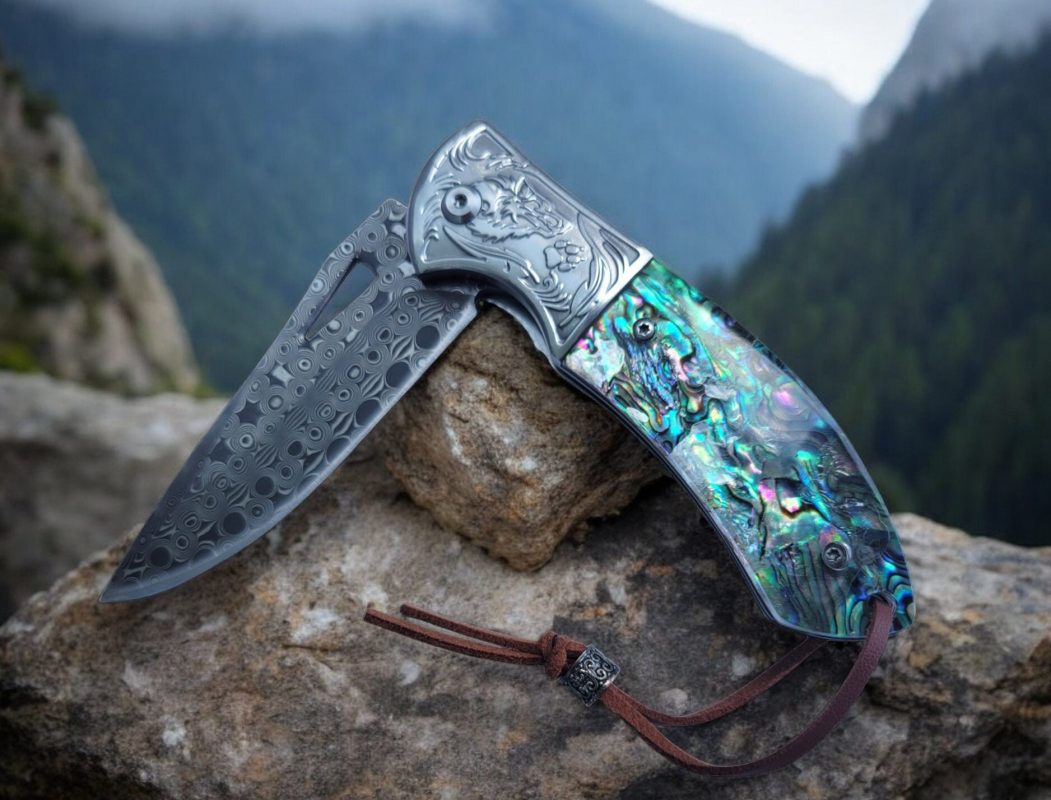
- Abalone shell handles: Wipe with a damp cloth and dry immediately. Do not use harsh chemicals. The iridescent surface is durable but can be scratched by abrasives.
Storage
For long-term storage, keep Damascus knives in a dry environment with good airflow. High humidity is the enemy of Damascus steel.
- Store with a light coat of oil on the blade.
- Use a knife roll, a display case, or an individual knife sleeve — not a leather sheath for long-term storage (leather can trap moisture).
- Do not store in a sealed plastic bag — condensation can build up inside.
- If storing in a display case, include a small silica gel pack to manage humidity.
Summary: Damascus Knife Care at a Glance
- After every use: Wipe dry, especially around the pivot and fuller.
- Monthly: Light coat of mineral oil or camellia oil on the blade.
- If rust appears: Oil and fine steel wool immediately, then re-oil.
- Sharpening: Whetstone at 15–20 degrees, medium then fine grit. Avoid pull-through sharpeners.
- Handles: Oil wooden and bone handles periodically. Keep all handles dry.
- Storage: Dry environment, oiled blade, good airflow.
With these habits in place, a quality Damascus steel knife will remain in excellent condition for decades — and continue to develop the rich, deep character that makes Damascus steel worth owning in the first place.
Browse the Fair Impex handmade Damascus steel folding knife collection — VG10 core, 67–107+ layers, natural handle materials, presentation gift box. View all Damascus knives here.
